Everything You Wanted To Know About Capos
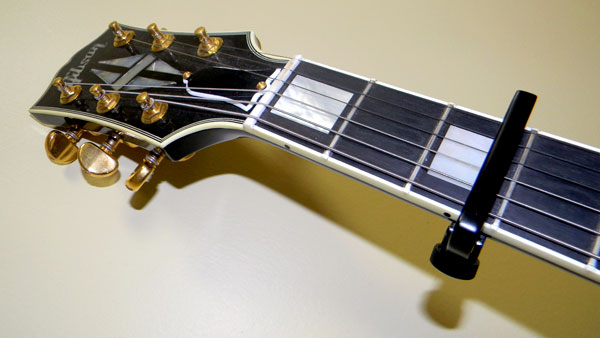
Every guitarist should own a Planet Waves capo. And that most definitely means you. No exceptions! Just consider what a capo can do for you as a guitarist. This deceptively simple tool is a fantastic resource on many different levels. For instance, the capo is the songwriter’s best friend, invigorating even the most familiar (in other words, tired) chord sequences progressions. For some aural evidence, take a look at The Beatle’s back catalogue and you’ll find dozens of examples where the band used a capo to add an element of freshness to their guitar arrangements. Just try playing George Harrison’s Here Comes The Sun (from The Beatle’s Abbey Road) on your guitar without a capo. It simply doesn’t sound as good! George added a capo at the seventh fret, his guitar sparkled beautifully, and he was inspired to record a timeless classic. That’s the beauty of the capo. Many other bands have used the same ‘trick.’ Planet Waves endorsees Shadows Fall, Alkaline Trio and Crosby Stills and Nash have all used a capo to add something special to their recordings. You see, a capo can transform the timbre, also known as the ‘voice’ of the guitar, adding a real sizzle to upper register chords; it even pushes a standard six-string guitar into mandolin territory when a capo is placed on the upper reaches of the fingerboard. In that respect, a capo is almost like an effects unit– a means to alter the voice of the instrument – in order to unlock new ideas and spark inspiration. The difference is, unlike an effects pedal, a capo doesn’t require batteries or cables to work its magic. Read more
Guitar Pickups – Picking the Right One
some information provided by Seymour Duncan – one of the top manufacturers of guitar pickups
First, what is a pickup?
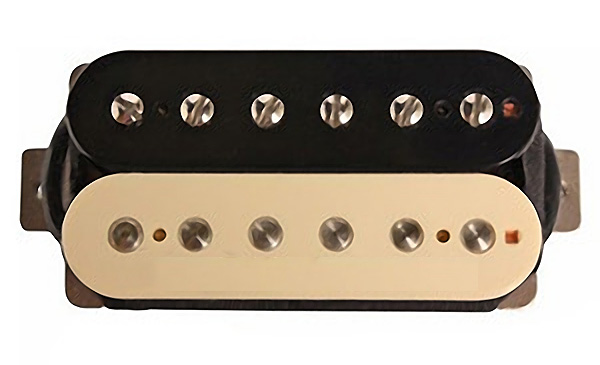
Technically, pickups are transducers that “pick up” string vibrations and translate them into an electrical current which then comes out of your amp as a tasty jazz run, a chunky power chord, or an in-yer-face death metal riff. Read more
Guitar Wiring Glossary of Terms
The electronics are an important and necessary component in electric guitars. Usually we will at one time need or want to rewire our guitar. Whether the need is for new pickups or replacement of a worn out knob or switch, knowing some basic terms that define how a component is installed helps in understanding this somewhat complex task.
SERIES: Two or more pickup coils wired so that the output of one coil feeds into the input of another coil. The result of this is a loss of treble and an increase of output. Example: a humbucking pickup is 2 coils in series.
PARALLEL: Two or more pickup coils wired so that each coils’ input has its own feed from the amplifier. The result is a tone somewhere between the tone of each coil individually with a slight decrease in output. Example: 1) a Strat with the 5 way switch in positions 2 and 4. 2) a Les Paul with with the toggle switch in the middle position.

Push Pull Pot
DPDT: Double-pole double-throw. This is a 2-way switch that has 2 separate switches in one. Each of 2 contacts in the switch can be routed differently depending on the switch’s position. Example: 1) a mini-toggle switch 2) a push / pull control.
PUSH/PULL: A Double-pole double-throw switch mounted on a potentiometer (volume control, tone control…). This switch is activated by pulling up or pushing down on a guitar’s volume or tone knob. This is useful for adding a switch without drilling additional holes in your guitar.
5 WAY: A standard Strat switch. The majority of my diagrams use a switch with 2 sets of contacts (like having 2 switches in one). Some less expensive guitars have only one set of contacts. It is suggested replacing these switches immediately; they can be unreliable and do not provide the awesome switching potential of the standard 5 way switch.

5 Way Switch
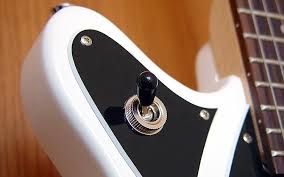
3 WAY: A standard large toggle (Gibson, Guild, Gretch, etc…). This switch is usually used for simple pickup switching, although it can also be used effectively in a more versatile wiring scheme.
“COMMON” TERMINAL: The terminal(s) on a switch that, when the switch is changed to different positions, makes contact with different terminals.
Ground Symbol
GROUND: Sometimes referred to as earth. An electrical ground is a common point in the guitar wiring that allows a signal or current to return to a common point. A good analogy is “You can think of a ground as a “sink” that electrical noise runs down”. Poor grounding in a guitar will cause the guitar to hum or buzz.
Cable Guy – Guitar Cable Guidelines
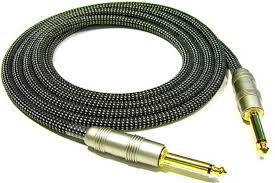
They’re everywhere – stuffed into gig bags, hanging on the wall, crammed into the back of your combo amp. Cables are the lifelines of your music and learning a bit more about their construction, and the difference between a low budget cable and one designed for premium audio applications is worth the effort.
Every time you plug in a cable from your guitar to your pedalboard or from one stompbox to the next, you expose your audio – your music – to interference. Buying the right high quality cable will ensure that your music gets to the ears of your audience sounding the same as it did when you imagined it in your head… and played it on your instrument. Read more